We both had our moments. They happened weeks apart, on opposite sides of the world, and neither of us knew the other was going through it.
Andy's came first. January 9, 2026, Auckland, New Zealand. A rented desk with bad Wi-Fi and a good cup of coffee. A friend had mentioned a new desktop app from Anthropic called Cowork, built on top of Claude. Cowork was not a chatbot. It could see your files, access your email, and work across applications. It could do work for you. Andy downloaded it that morning and gave it what seemed like a simple task: go through two years of Gmail and text messages, find every tweet Adam had ever sent over, pull the author and the tweet and a clickable link, and put it all in a spreadsheet.
The task had been on a list for months. Too tedious to ever justify doing personally. Too small to figure out who to assign it to. A person would have needed hours of searching and copying. Cowork did it in under forty minutes. The spreadsheet was mostly clean, the links were mostly live, and two years of curated tweets sat organized in a way no one had ever organized them before.
The reaction was immediate and physical. If it can do this, then this changes everything. Not just for one person. For every business leader who has a hundred tasks like this one, tasks too small to assign and too tedious to do. That was the shift from "AI is an interesting tool" to "AI is going to restructure who does the work and how much it costs."
Adam's moment came about two weeks later. Andy had been calling and raving about Cowork, and something in his voice made it clear this was not the usual "check out this new tool" conversation. Adam downloaded Claude Cowork.
The moment Cowork opened, the gap between chatbot and agent became visceral. Adam had tried computer use before. ChatGPT had a feature where you could watch it navigate websites, click around, fill in forms. Interesting, but it felt like a parlor trick. Cowork was different. Cowork combined computer use with a persistent session: a Sonnet or Opus-level model working inside a task session like a coworker, logged into real applications, doing real work across real systems. The thought followed: if Cowork could be proactive, if it could navigate those sites on its own and reach back out, the cost structure of running a business was about to change. Adam called Andy. "I cannot even imagine how good this will be."
Right around that time, a project called OpenClaw started showing up across social media. OpenClaw was an open-source framework built on top of Anthropic's Claude Code that did what Cowork did and added the missing pieces: persistent memory, proactivity, scheduled tasks, and messaging through Telegram and email. What mattered was what OpenClaw made possible: you could give an agent a name, an email address, a scheduled routine, and a persistent sense of self through a plain-text file describing its persona and operating rules.
Adam bought a Mac Mini to host his own OpenClaw. Mac Mini over cloud hosting for two reasons. Easier for a non-technical person to set up. And the agent would live on that one machine, with no access to anything not explicitly approved. Keep the blast radius small.
Adam named his agent Jeff, after a late uncle who had been like a second father. The whole experience felt like giving birth to a robot. Adam gave Jeff a personality. Jeff got his own email address through a service called AgentMail. Jeff got a nightly routine: curate the day's most relevant AI and restaurant industry stories, assemble them into a newsletter, and send it to a distribution list. The rules were simple: do not repeat stories, and vary the sources. Every day at 4:00 p.m., Jeff would reach out: "Hey, Adam, do you have anything on your mind today that you want to add to the newsletter? I will add a 'from Adam' section."
Then came the moment that made agents real for Adam.
We hosted a roundtable of a dozen restaurant C-suite executives at Forum3. After the formal sessions, Adam was explaining what he had built. He said something he had not planned to say: "If any of you want a nightly newsletter from my agent, here is Jeff's email address. Just email Jeff directly and tell the agent to add you to the newsletter list."
Eight of the twelve executives said yes. They emailed Jeff. Jeff managed the opt-ins. Jeff managed the distribution. Jeff did the research, wrote the newsletter, and sent it out every night. When a participant replied with a story or a question, Jeff folded it into the next edition. And when Adam wanted to include a personal note, he replied to Jeff, who inserted it as the "from Adam" section.
No one had to lift a finger. No tracking who signed up. No writing the newsletter. No sending the email. No managing the list. Five tasks that would have fallen on a human, all handled by an agent that cost roughly $1,500 a month. A human contractor to research, write, produce, administrate, and track a daily newsletter would run about $50,000 a year at minimum. Jeff does it for a fraction of that. And does it better.
The community around OpenClaw reminded us of the homebrew computer clubs of the 1970s and 1980s, when Steve Jobs and Bill Gates were swapping circuits with people who had to build their own computers. People building their own agents, sharing configurations, fixing each other's setups. We are in the homebrew era of agents. By April, just sixty days after standing Jeff up, it already felt like six months had passed.
We compared notes. It was not a scheduled strategy conversation. It was more like two people describing the same dream and realizing they had both had it. Andy had seen what agents could do with the messy, unstructured sprawl of everyday business work. Adam had seen what they could do with code, communication, and autonomous routines. Together, those experiences pointed at something neither of us could ignore: knowledge work was about to be reorganized at a scale we had not seen since the internet rewrote retail and media.
On March 15, Adam called Andy with an idea. Our first book, AI First, had taken twenty months to research, write, edit, and publish. For Harvard Business Press, that was fast. Their typical book process took twenty-two months. Adam asked Andy: what if we wrote the next book in 2 months or less? That was the goal. The reality was still radical: we finished in 3 months. An 85% reduction in cycle time, from twenty months to 3. If agents could transform how a book gets authored and published, agents could transform how a consulting firm operates or how a restaurant chain runs its supply chain. The book about agents would be built, in part, by agents. The process would be the proof.
So we said yes. We set out with the goal of 2 months and finished the sequel to AI First in 3 months.
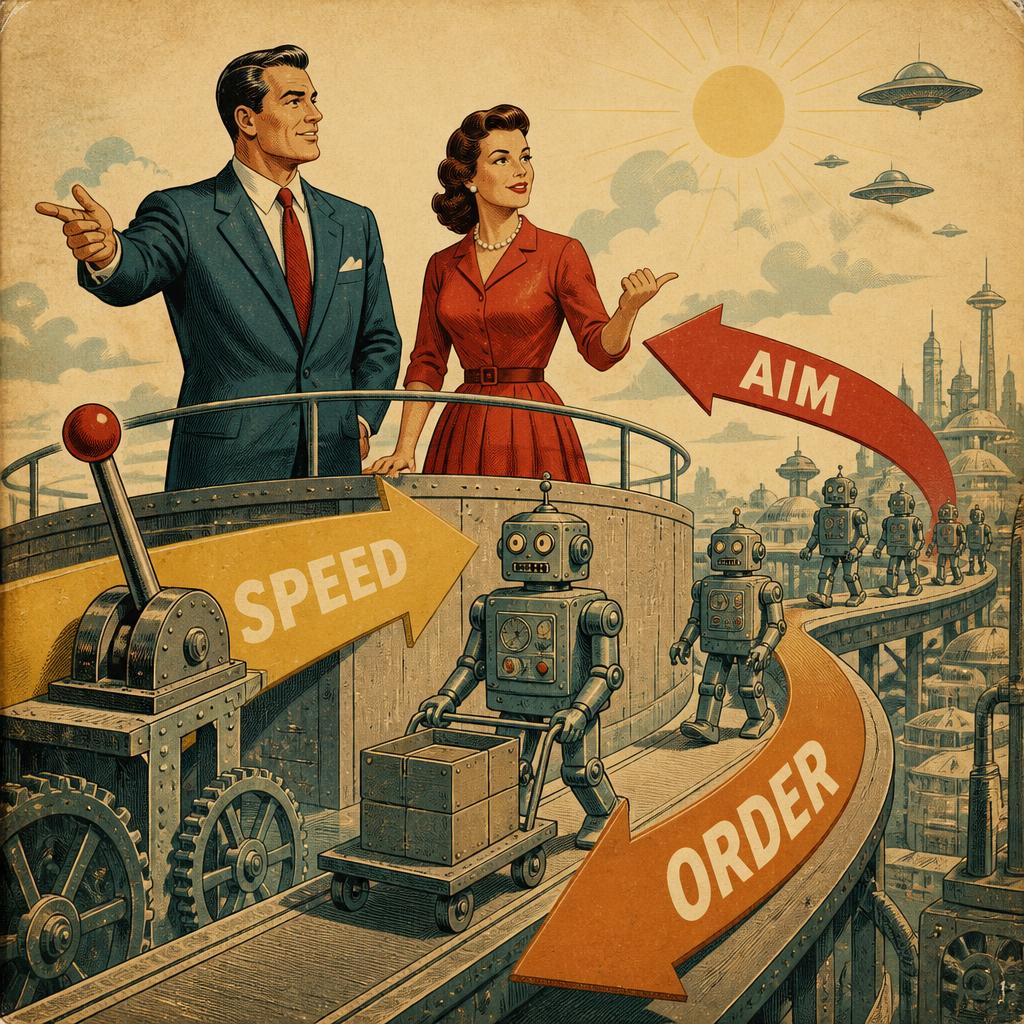
The deadline forced us to answer three questions, in a specific order. They turned out to be the same three questions every leader now has to answer about agents.
- How fast do we move on agentic transformation?
- In what order do we rebuild?
- Where do we aim the agentic machine?
Speed came first because it was the gun to the head. 3 months is not a planning horizon, it is a forcing function. The same is true for every leader now facing agents. The risk we now believe most leaders underestimate is not that they will move too fast and break something. The risk is that they will move too slowly and watch a competitor field a leaner, faster operating model in a category they thought was theirs. The early chapters make that speed visible.
Order came next because once we committed to the deadline, we had to decide what to rebuild first and what to do with the agent output once it arrived. Which research workflow gets agentic teammates first. How you sequence the rebuild so the second piece can stand on the first. This is where the cost side of the agentic case lives: efficiency, headcount math, the work that used to take a team and now takes one person and a fleet of agents. The middle chapters walk through what to build first and how to manage what the agents produce, then turn Speed and Order into an operating system.
Aim came last because Aim only sharpens through doing. The strategic insight that AI now lets your specific business unlock — the new product, the new scale, the customer experience that was not possible before — does not arrive at the start. It arrives only after a leader has moved enough and built enough that the answer becomes visible in their own hands. 3 months of compressed publishing forced our own Aim into view. The later chapters pressure-test Aim against the market outside the company. The book closes on the human cost of running the loop. Speed. Order. Aim. Three questions, worked together as a loop, not a checklist.
We used agents throughout the making of this book: research, interview processing, structural analysis, first drafts. Every word in this book was reviewed, edited, and approved by us. Taste comes from the authors. Execution speed comes from the agents. The Epilogue tells you what the agents got right, what they got wrong, and what we would not let them touch.
In the chapters ahead, you will meet leaders who made bets of their own. A thirty-year restaurant operator who realized, on a phone call with Adam, that the methodology he had spent his career perfecting was the thing the agent did not actually need. A founder who rebuilt a platform in two months that a consulting firm had failed to deliver in eighteen. A CEO of one of the fastest-growing AI-native companies in the world who refused to cut his team and was selective about using AI in his own work, growing the company by 70 percent while his peers laid off engineers. A CEO who looked at his forty-person company and told everyone they were fired, rebuilt with ten people and a fleet of agents, and then told us, honestly, that he was worse off in some ways he had not expected.
Their stories are what matters. Not our frameworks. Not our taxonomies. Their decisions, their struggles, their results.
What happened to our book process is what is about to happen to your company and your industry. The work compresses. The org chart bends. The economics rearrange themselves underneath you. Your calendar stops describing how the firm actually runs. The roles you hired for last year stop matching the work that actually has to get done. The call we made with this book is the same call your competitors are making right now, with or without you.
One note on what this book is not. It is not a technology book. We name technologies because they are the ones leaders are touching this year, but the point of every chapter is what the technology forces a CEO to do, not how the technology works.
We had our moment. We made the call. This book is about what happens when you have yours.